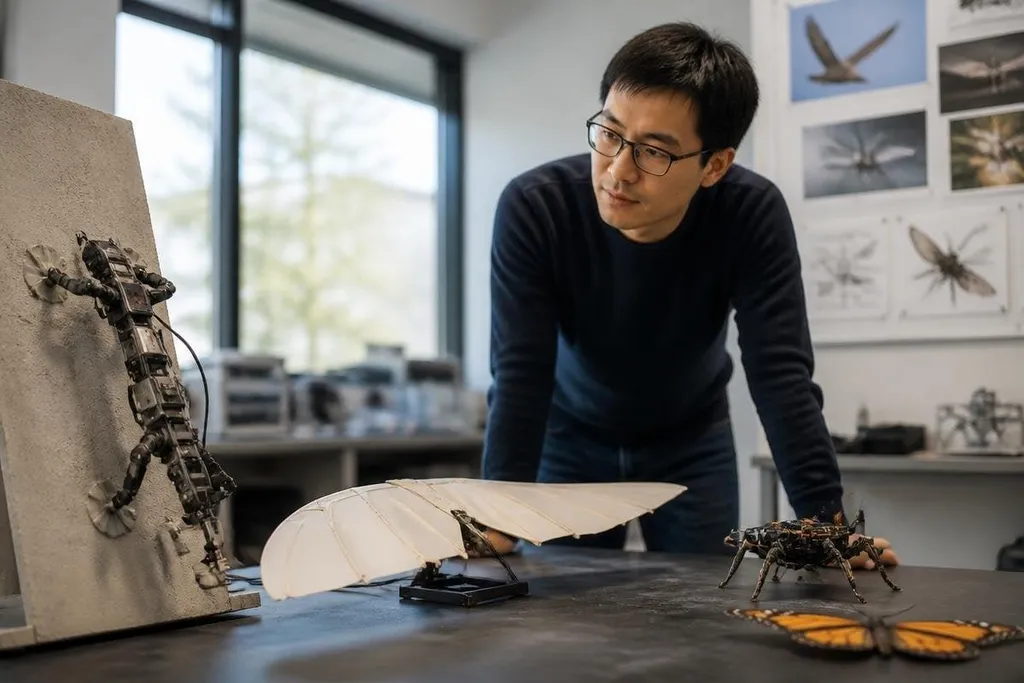
A robot can copy a gecko’s grip, a bird’s wing, or an insect’s way of sensing space. The useful lesson is usually a design rule, not a perfect copy of the animal.
- Soft feet can spread force across rough surfaces.
- Bird-like wings can guide air without a rigid spinning blade.
- Insect-style sensing can help a robot react with less computing power.
Nature gives engineers working ideas
Animals solve physical problems with bodies that match their surroundings. A gecko climbs by using many tiny contact points on its feet. A bird changes wing shape as it turns.
An octopus moves with a flexible arm that can bend around an object. Robotics teams study these actions, then rebuild parts of them with motors, springs, cameras, pressure sensors, or soft materials. The result may look nothing like the animal.
What matters is whether the design helps the robot grip, move, sense, or recover from a mistake. That shift changes how engineers start a project. They can ask how an animal handles a task before choosing a motor or a control method.
A machine for uneven ground may need flexible legs and good balance, while one working near people may need soft joints that give way under contact.
The body can do some of the work
Many robots depend on software to correct every small error. Bio-inspired designs can place part of that work in the body. A spring in a leg can store and release energy. A curved foot can spread pressure. A flexible arm can adjust to an object without measuring every surface point.
This approach is called mechanical intelligence. It means the shape and materials help the robot respond before its computer has finished a full calculation. That can reduce the amount of sensing and control the robot needs for a narrow task.
The trade-off is fit. A spring tuned for one weight or walking speed may behave poorly with another load. A soft gripper that handles fruit may lack the force needed for a metal part. Nature supplies useful patterns, but the robot still needs a clear job and a controlled work area.
Learning from movement and sensing
Animal movement also gives robotics teams ways to study balance. A legged robot can use a gait, or repeated walking pattern, that shifts its weight as each foot touches the ground. Researchers can test how that pattern handles slopes, loose soil, or a sudden push.
Sensors offer another lesson. Insects do not build a detailed map of every place they visit. They react to changes in light, motion, pressure, or airflow. A machine may use a similar strategy when a full 3D map would take too much time or computing power.
Use Robot 24 to compare a sensing rule with the robot, task, and test conditions behind it. A rule that reacts well to airflow in a lab may fail when dust or changing light enters the test, which is where the next section starts.
Where the idea can fail
Nature-inspired design can sound practical before anyone checks the cost. A flexible body may need special materials that wear out faster. A small sensor arrangement may work in a clean lab and fail when dust, glare, rain, or clutter changes the input.
There is also a scale problem. A feature that works on an insect may not work on a machine that weighs 50 kg. The robot needs stronger joints, larger batteries, and safety controls. Those parts can erase the benefit of the original idea.
The evidence needs to match the claim. A video of a robot walking across a flat floor shows that the gait works in that test. It does not show how the robot handles wet ground, long work periods, or a damaged sensor.
A practical check before you buy or build
Use this short guide when a project claims to copy nature:
- Name the task: write down the surface, load, speed, and work time.
- Find the copied rule: identify the body feature or sensing method the team used.
- Check the test setting: compare the demo floor, lighting, weather, and obstacles with your site.
- Ask about wear: find out which soft parts, springs, seals, or cables need replacement.
- Measure the gain: ask for a number tied to the task, such as fewer stops or lower power use.
I'd choose the nature-based design only when that rule solves a problem the standard design cannot handle at the same cost.
The next useful proof will come from longer trials outside the lab: more hours, rougher surfaces, and repairs recorded over time. Until those results appear, bio-inspired robotics is a sound source of design ideas, not a guarantee that the finished robot will work.